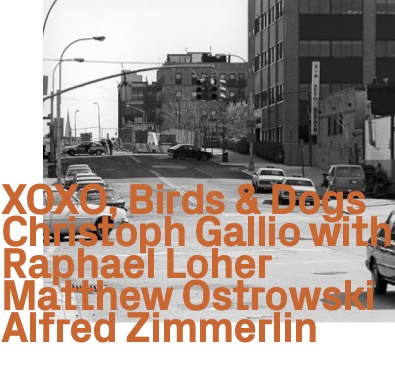
CD: CHRISTOPH GALLIO with RAPHAEL LOHER, MATTHEW OSTROWSKI, ALFRED ZIMMERLIN // XOXO / Birds & Dogs
2026, ezz-thetics HatHut CD // 74 Tracks // 49:38 Musicians: Christoph Gallio soprano & alto saxophone // Raphael Loher piano (XOXO) // Matthew Ostrowski arp synthesizer & sampling // Alfred Zimmerlin violoncello & electronics // Production notes: All compositions are by Christoph Gallio // XOXO is recorded Dezember 10, 2016 at Jazzkantine Luzern by Daniel Wehrlin; street sounds in Buenos Aires by Christoph Gallio in 2017; mixed & mastered by Michael Brändli, Hardstudios AG // Bird & Dogs recorded August 24 & 25, 1988 at Studio PASS in NYC by Charles S. Russell; mixed by Charles S. Russell & Matthew Ostrowski; merged by Max Spielmann & Johannes Vetsch at Eléphant Château Studio in Basel; mastered by Peter Pfister; restored and remastered by Michael Brändli, Hardstudios AG // Liner notes by Andy Hamilton in London // Graphic design by Stefabn Fuhrer at fuhrer vienna // Produced by Christoph Gallio & Hat Hut // Cover art by Beat Streuli
Samples
XOXO Beginning XOXO Beginning
XOXO Ending XOXO Ending
Birds & Dogs Birds & Dogs
Liner notes
by Andy Hamilton in London 2025
Christoph Gallio is probably best-known tor his pungent, sinewy Jazz trios, notably DAY & TAXI, which bring together composition, free jazz and free improv. However, the saxophonist also composes in more varied styles, and his new release features unexpected collections of pieces making up two works, XOXO and bird and dogs.
XOXO - "hugs and kisses" - began as a project for Zurich-based artist Caro Niederer. In 2017, she asked Gallio to create coffeehouse music for her new museum bistro. Gallio found some miniatures for solo piano and saxophone and piano that he'd composed, and wrote some more. They're rather minimal - Gallio describes XOXO as reminiscent of Erik Satie's "furniture music", a precursor of ambient music or muzak. He recorded them with pianist Raphael Loher, adding some contrasting freely improvised miniatures more in the style of DAY & TAXI. Later in 2017 he stayed for six months in Buenos Aires, where he made some field recordings that he integrated into XOXO - streetscapes he'd recorded from the studio window.
The album also includes one of Gallio's first compositions, birds & dogs, recorded in 1988 in New York City. "With bird & dogs everything is freely improvised", Gallio explains. "The compositional work was the sequence - the bricolage technique". There are nineteen miniatures, with Gallio on soprano saxophone, Matthew Ostrowsky on Arp synthesizer and sampler and Alfred Zimmerlin on cello with electronics. The birds and dogs pieces were performed a lot - and Gallio has resumed playing with Alfred Zimmerlin in a duo.
Gallio comments that in XOXO, "I place various beauties' side by side, almost randomly". This is a philosophical theme that preoccupies him - beauty. What is beauty? Who determines what is beautiful? "I was always interested in friction or what doesn't belong together," Gallio has commented. "The question of what constitutes beauty - connected with love (as kitsch as that sounds!) or longing (a great driving force in the arts)... also take kitsch very seriously - everyday life!" "I find melodies - even super kitschy ones - absolutely wonderful, he adds.
Those philosophical questions belong to the branch of philosophy known as aesthetics - the philosophy of art and beauty. Aesthetics also concerns everyday life - anything can reward aesthetic attention. But artworks can most richly reward such attention. When I speak to him online, Gallio explains that he doesn't know how people reacted to the pieces collected muzak. "I wasn't able to go....the music wasn't very loud in the cafe. It's kind of easy-listening but at the same time it isn't because you have disturbing things in it".
XOXO isn't abrasive, but nor is it bland. The pieces were written over a period of ten years: "It was not planned. I wanted to have lovely pieces - beautiful music, without sarcasm".
His work with DAY & TAXI sometimes has miniatures: "I was always interested in beauty. Because in my circle, this kind of beauty is evil". You mean free jazz and improv players reject it? "Yes. I played a lot with Irene Schweizer when I was a young guy. When I began to compose these things, she was not happy. She thought it's bullshit - capitalistic, made for supermarkets, I don't know. But this kind of dissonance can also be beautiful". But you sort of agree with her, because you were happy for this music to be used as muzak? "That's my provocative side", Gallio responds, impishly.
"Beauty" is an ambiguous term. In one sense, the sublime, abrasive, spiky or dissonant is ruled out. But in a second sense, "beauty" is the most general term of aesthetic approval. Who decides what is beautiful? I'd argue that we all do. The great 18th century philosopher and founder of aesthetics, Immanuel Kant, had a compelling take on this question. For him, aesthetic judgments are perceptual and concern appearance - aesthetics is about seeing or hearing things in a certain way. Kant argued that "This is beautiful" is a subjective-y universal judgment. That does not mean that it is purely subjective.
I would argue that reasons can be given for such judgments. They are subjective in the sense that we decide for ourselves, but not by ourselves. We discuss artworks among ourselves, read critics, and make critical judgments. I think it's democratic. "I think that's true - but in my life l've met a lot of people who thought they could say what is beautiful and what is not". That's the question of the expert - but if someone says "I'm not interested in working out my own view, I'm just interested in what the experts think" - that's crazy.
In his aesthetics, Kant focused almost exclusively on beauty - though he did contrast it with the sublime. The 20th century ordinary language philosopher J.L. Austin, who focused on the particular rather than the general, wished that "we could forget for a while about the beautiful and get down instead to the dainty and the dumpy". Mary Mothersill responded that if we forget about the beautiful we will not get far with the dainty and the dumpy. But to be fair to Austin, he did write that "if we could forget for a while about the beautiful..".
Gallio is making an important statement with this album, therefore a statement about beauty. Instead of saying "It's bullshit, free players could just say "It's not to my taste". That's the difference between admiring, and loving or liking. For instance, I admire Evan Parker's music, but can't say that I always love it. This may be true of much difficult art. It's not true of XOXO and birds and dogs - music to admire and to love.